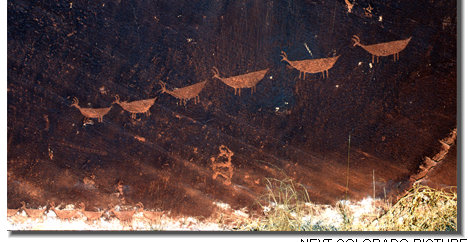
Here, Pronghorn antelope (forward facing horns, as opposed to bighorn sheep) descend to the watrer, and a
small seated figure
works at an un-
certain chore.


|
We were kicked back in the sled eating lunch at a place we had nicknamed "frustration bar" for the difficult fish when a huge double pontoon people barge pulled up and landed next to us. The Ranger stood up and said to the 15 tourists, "You can use the rest rooms on the hill up the path and then we will assemble at the base of the cliff to discuss the pictograph wall here, the biggest and best one in the canyon". We looked at one another, sandwiches went flying, and we joined the group. It was spectacular. The black patina on the sandstone takes 2000 years to develop, so rock events can be roughly dated by it's development. The river, as the only reliable source of water in a vast desert, was the center of most biological life, and most if it compressed in the narrow strip of flattish land between the water and the cliffs. In the pre-dam river, all potential archeological accumulations were washed away with the yearly spring floods. The pictographs, 2000+ years old, are all that remain. Here, Pronghorn antelope (forward facing horns, as opposed to bighorn sheep) descend to the watrer, and a small seated figure works at an un- certain chore. |
|||||||||||||
|
|
|||||||||||||
| Colorado 16 | |||||||||||||
| <= BACK | |||||||||||||
|
|
|||||||||||||
|
|
|||||||||||||
| Flyfishing TOC | |||||||||||||
| Table of Contents | |||||||||||||